
Updated by
Hi, I'm Jack, the owner of Cybersecurity Jobs List, and co-founder of Himalayas (himalayas.app) and Cavuno (cavuno.com). Across all my platforms, I work with application security daily: dependency vulnerability scanning, secure authentication, API security, and data protection across hundreds of thousands of users. My technical background is in computer science (UNSW), where he studied security engineering and computer networks, and worked as a research assistant on VR experiments that were published in the Journal of Experimental Psychology. I also work with cybersecurity hiring data every day, tracking which companies are posting, what certifications actually appear in listings, how salaries differ by sub-discipline and clearance level, and where the talent gaps are widest. That combination of security practice, engineering at scale, and daily immersion in the hiring data is what shapes the content on this site. I'm currently based in Sydney, Australia.
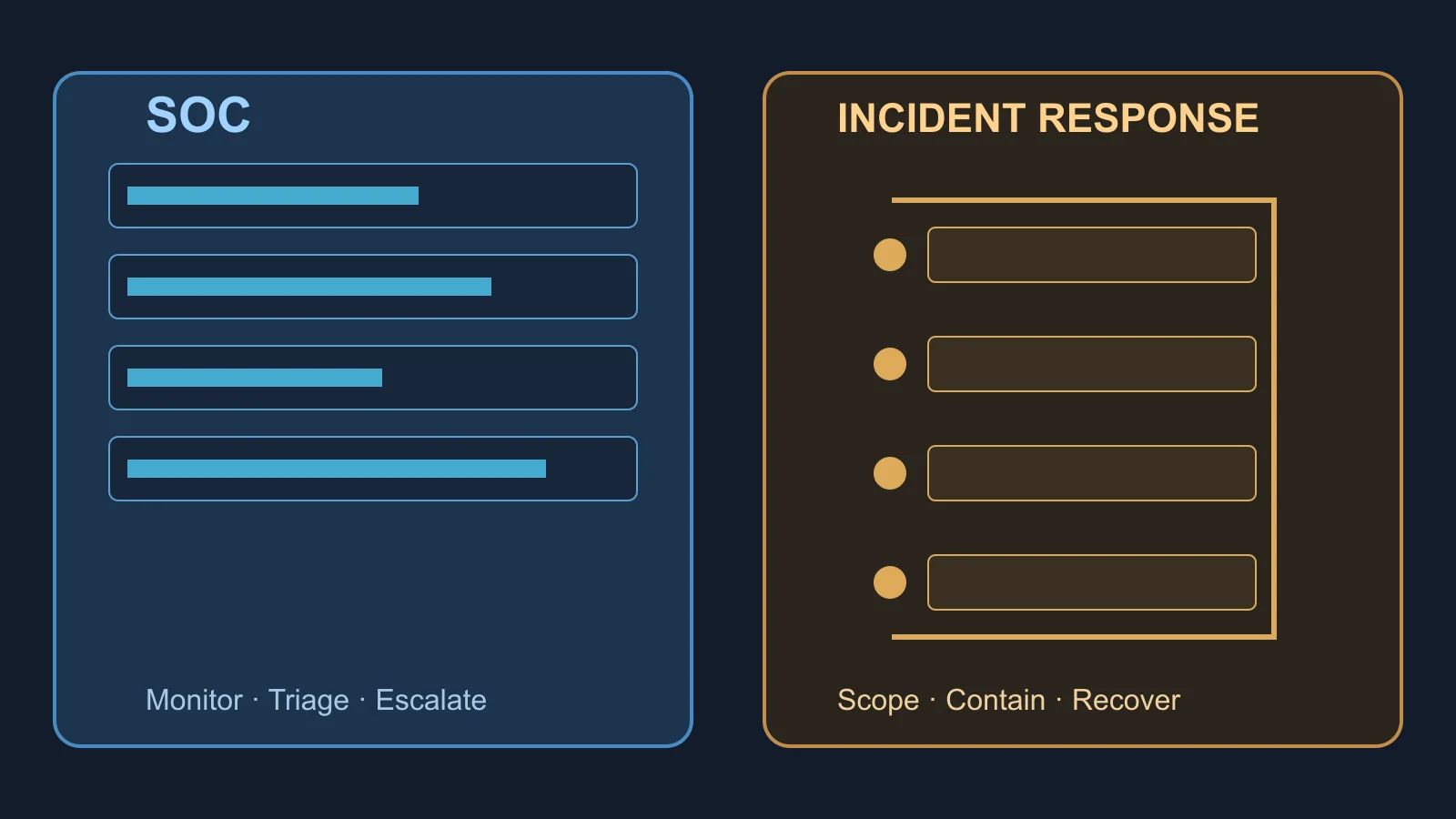
SOC analyst and incident responder titles often appear next to each other in cybersecurity job ads. Both roles defend the organization. They are not the same job. A SOC analyst usually lives in the monitoring and triage queue. An incident responder usually takes ownership once something is treated as a real incident that needs containment, deeper investigation and recovery work.
Frameworks such as the NICE Workforce Framework for Cybersecurity describe related work roles rather than a single universal job description. Employers still invent their own titles. Use this guide to separate the day-to-day work, read mixed ads honestly and decide which path fits you.
What each role usually owns
A SOC analyst works inside a security operations function. Typical work includes watching alerts from SIEM, EDR, identity, cloud and network tools; deciding whether an event is noise, suspicious or incident-worthy; enriching context; documenting findings; and escalating according to playbooks. CSJL’s own SOC analyst tiers guide covers how L1, L2 and L3 labels often split that queue work. The center of gravity is continuous detection and triage.
An incident responder (also called incident response analyst, handler or cyber defense incident responder) focuses on investigating, analyzing and resolving cybersecurity incidents. The NICE Incident Response work role includes tasks such as triage of defense incidents, determining scope and impact, coordinating response functions, correlating incident data and recommending remediation. CISA’s Cyber Defense Incident Responder description likewise emphasizes investigation, analysis and response inside the network environment. The center of gravity is confirmed or high-confidence incidents, not every raw alert.
In small teams the same person may do both. In larger programs the handoff is clearer: SOC qualifies and packages the case; IR leads containment and deeper analysis. Neither pattern is “wrong.” Read the vacancy, not the industry stereotype.
Side-by-side comparison
| Area | SOC analyst (typical) | Incident responder (typical) |
|---|---|---|
| Primary question | Is this alert real, how serious is it, and what happens next? | What happened, how far did it go, and how do we contain and recover? |
| Usual starting point | SIEM or tool alert, ticket, or detection queue | Escalated case, confirmed incident, or high-severity event |
| Time horizon | Minutes to hours per case in a continuous queue | Hours to days (or longer) for scoped incident work |
| Common outputs | Triage notes, false-positive/true-positive decisions, escalations | Incident timeline, scope assessment, containment actions, lessons learned |
| Evidence depth | Enough context to decide and escalate cleanly | Often deeper host, identity, malware or forensic work when required |
| Overlap | May perform initial containment and short investigations | May use the same SIEM and EDR tools the SOC uses |
NIST’s broader incident response guidance places detection, response and recovery inside a wider risk-management cycle. That is organization-level process language. Individual job ads still decide how much of Detect versus Respond sits in one seat.
Same incident, two jobs
Here is a labeled fictional example. It is not a real case and not a claim about any employer’s process.
Alert: Multiple failed logins followed by a successful login from a new country for a privileged SaaS admin account, plus unusual mailbox forwarding rules.
- SOC analyst path: Confirm the alert is not a known travel pattern or broken detector. Pull identity logs, recent password resets, MFA status and related endpoint alerts. Mark severity, capture indicators, open or update a ticket, and escalate with a clear summary: what was seen, what was checked, what remains unknown, and recommended next steps.
- Incident responder path: Treat the case as an identity compromise investigation. Expand scope across related accounts and systems, coordinate containment (session revoke, credential reset, rule removal), preserve evidence to the organization’s standard, rebuild a timeline, and document recovery and hardening recommendations for owners.
Notice the tools can look similar. The ownership and finish line differ. If you enjoy high-volume pattern recognition and clean escalations, SOC work may fit. If you prefer fewer cases with deeper scope and cross-team coordination under pressure, IR work may fit.
How job ads mix the titles
Employers blur labels. Use the responsibilities section more than the title.
| What the ad emphasizes | More SOC-like | More IR-like |
|---|---|---|
| Shift coverage, alert SLAs, ticket volume | Yes | Sometimes, if on-call only |
| “Triage,” “monitor,” “escalate,” “tune detections with senior staff” | Yes | Less central |
| “Lead incidents,” “forensics,” “malware analysis,” “root cause,” “tabletop facilitation” | Possible at senior tiers | Yes |
| On-call for major incidents only | Common in hybrid roles | Common |
| Metrics | Queue time, false-positive rate, escalation quality | Time to contain, scope accuracy, recovery quality |
If one posting says “SOC analyst” but lists memory forensics and enterprise IR lead duties, treat it as IR-heavy. If it says “incident responder” but only lists SIEM monitoring on a 24x7 roster with no investigation ownership, treat it as SOC queue work. Ask the hiring contact which team owns major incidents end to end.
Skills and evidence without inventing experience
You do not need classified war stories to show fit. Prefer honest, scoped evidence:
- For SOC-leaning applications: alert investigation notes from labs, detection write-ups, documented false-positive analysis, and familiarity with log sources. Link practical SIEM concepts from our SIEM vs SOAR guide only when you can explain them in your own words.
- For IR-leaning applications: a safe fictional or lab incident timeline, containment decision tree, evidence-handling notes that respect legal and employer rules, and clear stakeholder updates. Do not claim real breach work you did not do.
- Shared foundations: networking and identity basics, endpoint concepts, disciplined documentation, and calm communication.
NICE work-role task lists are useful vocabulary for resumes and interviews. They are not a checklist every private employer will use, and they are not a certification by themselves.
Fit checklist
- Do I want a continuous queue of alerts, or fewer deeper cases?
- Am I comfortable with shift or follow-the-sun patterns if the employer runs them?
- Do I prefer packaging a clean escalation, or owning containment with other teams?
- Which tools does the posting actually name, and can I learn them without pretending mastery?
- Does the posting separate detection engineering, threat hunting, forensics and IR, or collapse them into one seat?
- What does success look like in the first 90 days according to the manager, not a blog post?
Write short answers for yourself before interviews. That is more useful than memorizing title definitions.
Keep the next step practical
Browse current roles on the SOC analyst collection, read how tier labels vary in the SOC tiers guide, or clarify tooling language with SIEM vs SOAR. When an offer arrives, separate schedule, on-call, scope of authority and investigation depth the same way you would separate pay and location.
Checked 30 October 2026. Role designs vary by employer. This article is general career information, not a hiring guarantee or a claim about any specific vacancy.
Related posts

A practical cybersecurity return-to-work guide: map earlier experience to current role tasks, refresh a specific gap, and prepare a clear, honest explanation.

Compare four selected OT cybersecurity openings, with location, experience, travel and eligibility checks. Employer pages checked 31 October 2026.

Learn what active, eligible and sponsored clearance language means in cybersecurity job ads, with official US, Australian and UK guidance.