
Updated by
Hi, I'm Jack, the owner of Cybersecurity Jobs List, and co-founder of Himalayas (himalayas.app) and Cavuno (cavuno.com). Across all my platforms, I work with application security daily: dependency vulnerability scanning, secure authentication, API security, and data protection across hundreds of thousands of users. My technical background is in computer science (UNSW), where he studied security engineering and computer networks, and worked as a research assistant on VR experiments that were published in the Journal of Experimental Psychology. I also work with cybersecurity hiring data every day, tracking which companies are posting, what certifications actually appear in listings, how salaries differ by sub-discipline and clearance level, and where the talent gaps are widest. That combination of security practice, engineering at scale, and daily immersion in the hiring data is what shapes the content on this site. I'm currently based in Sydney, Australia.

A cybersecurity job may require a security clearance, but plenty of cyber work does not. The tricky part is that job ads use phrases such as “active clearance required,” “eligible to obtain” and “must be able to obtain” as if they all mean the same thing. They do not tell you the same thing about when you need clearance or whether an employer will start the process.
A clearance is tied to a role and the access it needs. The employer or government organisation decides whether the position requires it, and the relevant authority makes the vetting decision. You cannot simply apply for a clearance on your own and take it to a job. The details also differ between countries, so read the posting for the country where the role is based. DCSA explains the US position-based process; UK Security Vetting describes its sponsor-led process; and Australia’s AGSVA explains sponsorship and eligibility.
First, separate clearance from other checks
A security clearance is an official decision connected to access to protected or classified information, facilities or systems. It is not a general certificate that proves someone is trustworthy for every employer, and it does not replace the employer’s decision about a role.
A job ad might also mention a background check, suitability determination, right-to-work check or pre-employment screening. Those can matter just as much to your application, but they are not automatically a national-security clearance. For example, the US federal hiring guidance says not every federal job requires a security clearance, while federal positions have a suitability determination. In the UK, the Baseline Personnel Security Standard (BPSS) is a pre-employment standard, not national security vetting. Check what the specific employer means instead of treating every “security check” as the same process. (USAJOBS/OPM; UK government BPSS guidance)
The rules depend on where the job is based
These examples show why one country’s clearance advice should not be copied into another country’s application. They are a starting point for reading the ad, not a personal eligibility decision.
| Where the job is based | What official guidance says | What to check in the advert |
|---|---|---|
| United States | Clearance is position-based. The employing organisation decides whether classified access is needed and starts the process; individuals cannot apply for a personnel clearance by themselves. Not all cyber or federal jobs require one. | Does the posting require an active clearance at application, or say one may be obtained after selection? Does it separately name citizenship, work authorisation, location or contract conditions? |
| Australia | A sponsoring government or business entity is required. Australian citizenship and a checkable background are the usual eligibility requirements; a sponsor may request an exceptional waiver, but that does not guarantee a clearance. | Is citizenship stated as a role requirement? Is the employer able and willing to sponsor the process? Ask the vacancy contact about your particular circumstances rather than assuming a waiver. |
| United Kingdom | A role sponsor confirms that vetting is needed and starts the process after the relevant baseline checks. BPSS is distinct from national security clearance. Nationality and residence considerations depend on the post and level. | What level is named? What baseline checks, right-to-work conditions or residence history does the vacancy state? Ask the vacancy holder if your history is unusual. |
Sources: NIST NICE FAQ, DCSA FAQs, USAJOBS/OPM, AGSVA eligibility and suitability, UKSV applicant guide, and UK government clearance levels.
Do not assume a clearance from one country automatically satisfies another country’s requirement. Even within one system, an employer may need to confirm current status, level, access and whether the role can use it. Ask the employer’s security contact what applies to that vacancy.
What common job-ad phrases do and do not tell you
| Wording in the posting | What it tells you | What it does not prove |
|---|---|---|
| “Active/current [level] clearance required” | The employer says the named status is required. Treat it as an existing gate unless the posting or recruiter clarifies otherwise. | It does not tell you whether an old, inactive or different-level clearance will be accepted. |
| “Must be able to obtain [level]” | The role requires that level by some point. | It does not, by itself, promise that the employer will sponsor every applicant or say whether you need it before starting. |
| “Eligible to obtain” or “clearable” | The employer may be describing a candidate who could be considered for a process. | It is not a vetting result, guarantee of eligibility, interview, offer or sponsorship commitment. Ask what the employer means. |
| “Clearance preferred” | The employer describes clearance as preferred in that part of the ad. | It does not settle other requirements elsewhere in the advert or contract. Read the full posting. |
| “Background check” or “suitability check” | Some form of screening may be part of hiring. | It does not automatically mean a national-security clearance is required. Ask which process and when. |
Employers and agencies use their own wording. The exact requirement in the full vacancy notice and the answer from its hiring or security contact matter more than a phrase copied from another advert.
A hypothetical example: a SOC analyst posting
Suppose an advert says: “Active Secret preferred; must be able to obtain Secret. U.S. citizenship required. On-site in Chantilly.” Treat those as separate statements, not one combined clearance rule:
- “Active Secret preferred” says an existing clearance is desirable, not that the line alone makes it mandatory.
- “Must be able to obtain Secret” says the role needs that level, but the posting has not told you whether the employer will initiate vetting after an offer or when the clearance must be granted.
- “U.S. citizenship required” is a separate stated condition. Do not infer that the clearance wording overrides it.
- “On-site in Chantilly” is a location requirement. Classified work may affect where duties can be performed, but ask the employer about the actual arrangement rather than guessing from the clearance alone.
Before applying, ask the vacancy contact: “The advert says an active Secret is preferred and that the successful candidate must be able to obtain one. Is an active clearance required when applying, or can the selected candidate be sponsored after an offer? When would it need to be granted, and are there any separate eligibility or location requirements?”
That question is specific and does not ask the employer to predict a government vetting result.
A quick checklist before you apply
- Find the exact level and status. Is it active, current, transferable, preferred, or something to obtain later?
- Look for a separate gate. The ad may state citizenship, work authorisation, residence history, contract eligibility, location or an existing clearance separately.
- Check timing. Does the role need clearance before interview, before start, or before access to a particular system? If the ad is silent, ask.
- Ask who starts the process. A recruiter’s “eligible” label is not the same as an employer commitment to sponsor you.
- Do not assume portability. Ask the receiving employer or security office to confirm whether an existing status is current and usable for this role.
- Keep applying to other cyber work. NIST’s NICE program notes that many cybersecurity roles do not require a clearance, including many private-sector roles. Look at the actual responsibilities, employer and requirements rather than ruling out an entire field.
If the wording remains unclear, apply the same method used for other job requirements: save the posting, separate minimum requirements from preferences, and map each to honest evidence from your work, study or projects. CareerOneStop’s job-posting guide recommends reading the full ad and distinguishing preferred from minimum qualifications. Do not claim a clearance you do not hold or imply that a lab or course is an equivalent clearance.
Keep the next step practical
A clearance requirement is one part of role fit, not a verdict on your cybersecurity career. Verify what the employer actually needs, keep each country’s process separate, and use the official source or vacancy contact for case-specific questions. You can browse current cybersecurity jobs, compare the terms of an offer with our cybersecurity job-offer scorecard, or see how a particular role is described in this threat-intelligence analyst guide.
Checked 27 October 2026. Official rules and individual vacancy requirements can change. This article is general career information, not legal, immigration or clearance-eligibility advice.
Related posts

A practical cybersecurity return-to-work guide: map earlier experience to current role tasks, refresh a specific gap, and prepare a clear, honest explanation.

Compare four selected OT cybersecurity openings, with location, experience, travel and eligibility checks. Employer pages checked 31 October 2026.
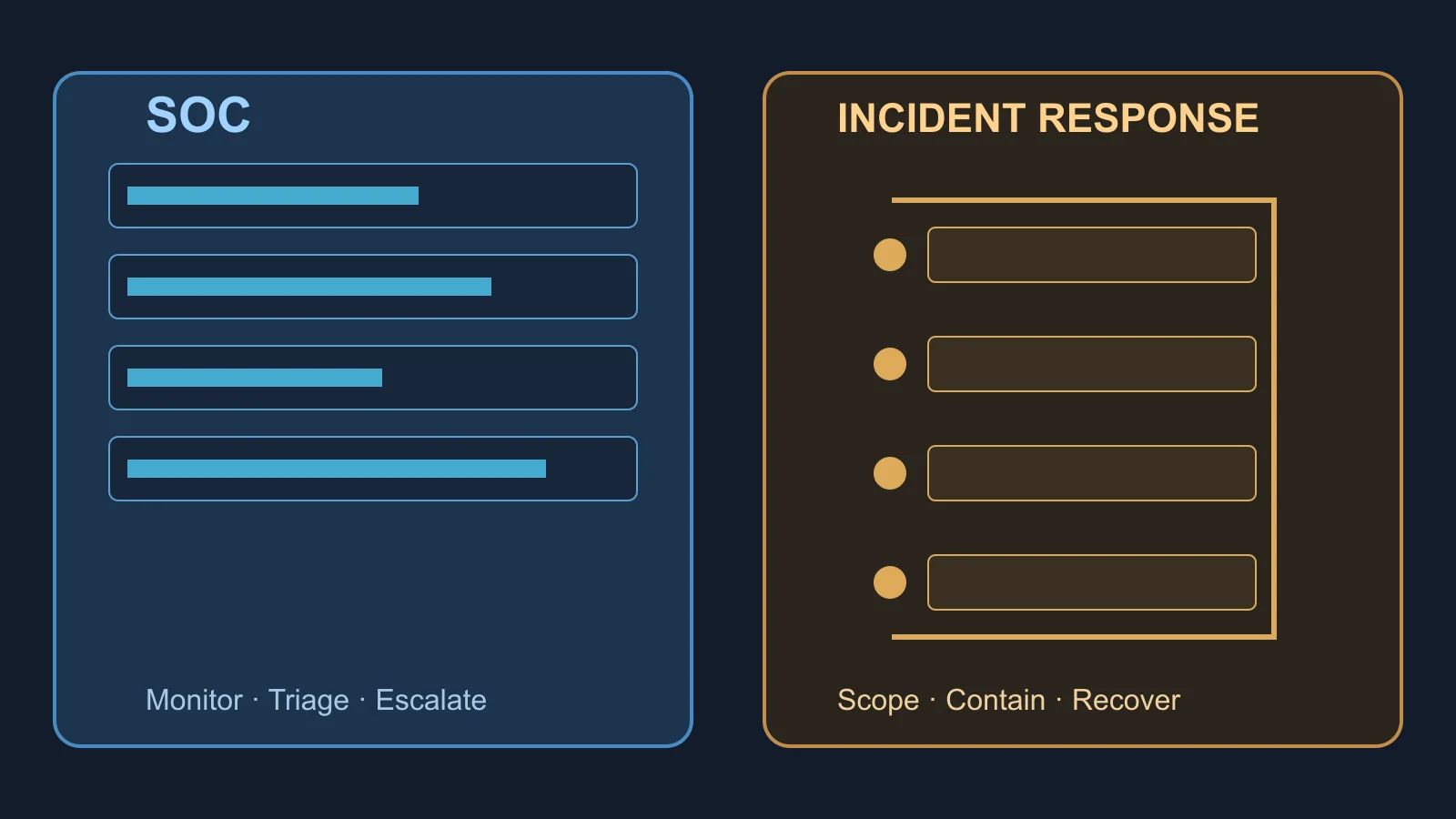
Compare SOC analyst and incident responder work: triage versus deep response, a same-incident example, how ads mix titles, and a fit checklist.