
Updated by
Hi, I'm Jack, the owner of Cybersecurity Jobs List, and co-founder of Himalayas (himalayas.app) and Cavuno (cavuno.com). Across all my platforms, I work with application security daily: dependency vulnerability scanning, secure authentication, API security, and data protection across hundreds of thousands of users. My technical background is in computer science (UNSW), where he studied security engineering and computer networks, and worked as a research assistant on VR experiments that were published in the Journal of Experimental Psychology. I also work with cybersecurity hiring data every day, tracking which companies are posting, what certifications actually appear in listings, how salaries differ by sub-discipline and clearance level, and where the talent gaps are widest. That combination of security practice, engineering at scale, and daily immersion in the hiring data is what shapes the content on this site. I'm currently based in Sydney, Australia.

A career break can make a cybersecurity job search feel like you have to start again. Usually, the first useful step is smaller: choose one kind of work, reconnect your earlier experience to its current tasks, and show what you have refreshed.
There is no single returner route. The pause may have lasted months or years, and it may have followed caregiving, health, study, redundancy or a deliberate change. You do not need to explain private details here. Start with the role you want to do next.
Begin with the work, not the title
“Security analyst” can mean different things across employers. One team may want alert triage and escalation. Another may focus on access reviews, vulnerability follow-up or control evidence. Read a few current employer descriptions and note the tasks that recur in the role you actually want.
The NIST NICE Framework can help you describe that work. It breaks cybersecurity capability into Task, Knowledge and Skill statements, and explains that a Work Role groups work rather than naming a particular job. Treat it as a vocabulary and planning aid, not a hiring test or a substitute for the employer’s own requirements. (NIST NICE Framework)
Try this evidence map for one target role:
| Earlier work | Task in the posting | Evidence I can show | One next proof |
|---|---|---|---|
| What did I own or support? | What would this person do? | A result, document or example | One small exercise or refresher |
For example, someone returning from systems administration might see access reviews and log investigation in a security analyst posting. Their earlier access-review work may be relevant. They could refresh one current log platform using a safe lab, then write a short, fictional incident note showing what they checked and how they would escalate uncertainty. That note demonstrates recent practice; it does not prove the person meets every employer requirement.
Refresh the gap you found, not the whole field
After mapping your evidence, choose one gap that matters to the target work. If current postings repeatedly ask for cloud identity, practice reading an identity event and documenting a reasonable next check. If they ask for vulnerability follow-up, produce a small example that ranks findings by affected asset and exposure, then records what still needs validation. Keep exercises in systems you own or have permission to use.
The NIST job-seeker project suggests documenting what you learn from hands-on labs. That is a useful principle: a short note explaining the question, method, observation and limit can make an exercise easier to discuss than a bare tool list. (NIST job-seeker project)
Do not buy a course or certification just to make the break look smaller. First check the employer’s required qualifications and whether the missing capability can be demonstrated another way. NIST’s job-description guidance asks employers to distinguish needed tasks and credentials from preferred ones, but each vacancy sets its own criteria. (NIST employer guide)
Show your history clearly and honestly
Keep the dates and titles of earlier jobs accurate. Put the most relevant accomplishments where a reader can find them, even if they are not recent. Then add any current work separately and label it accurately: a personal lab, volunteer project, refresher course or contract is not the same as paid employment.
You can keep a gap explanation brief. Some people name the break on a resume; others address it in a cover letter or conversation. Follow the application’s instructions and local norms. You do not need to share private details that are not relevant to the work. Avoid implying that a project happened for an employer when it did not.
Federal applications have specific rules. USAJOBS currently says federal resumes must be two pages or fewer and directs applicants to follow each announcement’s qualifications and document requirements. That is federal guidance, not a universal rule for private-sector resumes. (USAJOBS resume guidance)
Prepare a straightforward interview answer
If asked about the pause, you can choose how much context to share, then turn to the work you want to do. A useful structure is:
- Name the earlier work that connects to this role.
- Describe the pause briefly, at the level of detail you are comfortable sharing.
- Give one recent example of how you refreshed or demonstrated a relevant skill.
- Explain why this particular work is your next step.
Fictional example: “Before my break, I supported identity and endpoint operations. I stepped away from full-time work for personal reasons. Recently I reviewed access-control events in a lab and wrote up the checks I would make before escalating an unusual sign-in. I’m now looking for a role where I can combine that operational background with security monitoring.”
Change the example to match your real work. If you have not completed a lab, do not say you have. You can instead describe what you plan to refresh and ask a clear question about the role’s expectations.
A manageable first week
- Choose one target: select a role family and two or three current postings in your location and eligibility range.
- Map your evidence: list the tasks, earlier examples, current tools or knowledge to check, and one concrete gap.
- Create one proof point: complete a safe exercise or refresh one skill, then write down what you did, found and could not conclude.
- Tailor and verify: update the relevant resume section, follow the employer’s application instructions, and re-open the original posting before applying.
Cybersecurity paths are not all linear. NIST describes multiple entry and exit points and different routes through the field, so a return does not automatically mean restarting at the first rung. The practical question is which role matches your current evidence and what, if anything, you still need to refresh. (NIST on multiple career pathways)
When you are ready, browse current cybersecurity jobs. For the next step, see our guides to cybersecurity projects for a resume and preparing for a cybersecurity interview.
Related posts

Compare four selected OT cybersecurity openings, with location, experience, travel and eligibility checks. Employer pages checked 31 October 2026.
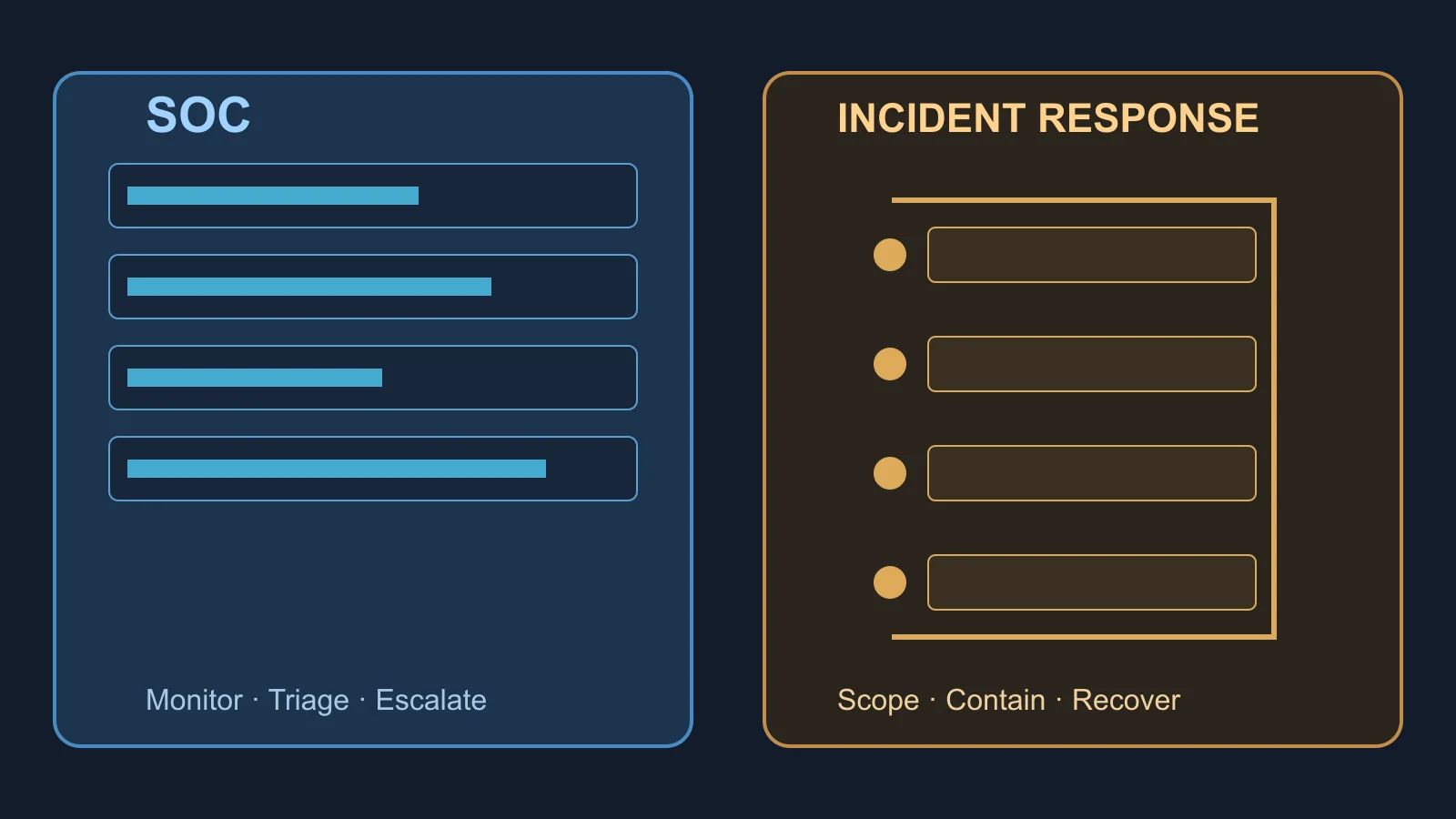
Compare SOC analyst and incident responder work: triage versus deep response, a same-incident example, how ads mix titles, and a fit checklist.

Learn what active, eligible and sponsored clearance language means in cybersecurity job ads, with official US, Australian and UK guidance.