
Updated by
Hi, I'm Jack, the owner of Cybersecurity Jobs List, and co-founder of Himalayas (himalayas.app) and Cavuno (cavuno.com). Across all my platforms, I work with application security daily: dependency vulnerability scanning, secure authentication, API security, and data protection across hundreds of thousands of users. My technical background is in computer science (UNSW), where he studied security engineering and computer networks, and worked as a research assistant on VR experiments that were published in the Journal of Experimental Psychology. I also work with cybersecurity hiring data every day, tracking which companies are posting, what certifications actually appear in listings, how salaries differ by sub-discipline and clearance level, and where the talent gaps are widest. That combination of security practice, engineering at scale, and daily immersion in the hiring data is what shapes the content on this site. I'm currently based in Sydney, Australia.

This article preserves the reported Cybersecurity Jobs List snapshot from 29 August 2026. It does not describe jobs available today. The counts below refer to listing labels in that historical sample, not verified permission to work remotely from any country.
For a more recent, source-checked shortlist, see our companies hiring remote cybersecurity professionals guide. Each role has its own location and experience requirements; check the employer's current posting before applying.
Correction, 29 September 2026: We have clarified the age and limits of this report, withdrawn conclusions based on inconsistent breakdowns and removed salary comparisons we could not independently reproduce. The original publication date and the reported overall sample counts remain unchanged.
What the August report recorded
The original report recorded 6,029 published listings. It excluded 98 listings using sales and go-to-market title rules, leaving 5,931 records described as practitioner-facing. That title-based rule was not a manual assessment of every role's technical responsibilities.
| Recorded work arrangement | August count | Share of 5,931 |
|---|---|---|
| Remote | 676 | 11.4% |
| Hybrid | 1,418 | 23.9% |
| On-site | 3,835 | 64.7% |
These three counts add to 5,929, two fewer than the reported 5,931 records. We have retained the original figures to make that discrepancy visible; we cannot determine the missing records' arrangement from the summary. The percentages shown use the originally reported denominator of 5,931. They do not establish that every listing was open, correctly classified or a unique employer vacancy. We have not reconstructed the complete original listing-level extraction, deduplication or employer-source validation.
The original work-mode method used the board's arrangement field. It did not establish an applicant's permitted country, work authorization, required office attendance or travel. The sample also cannot tell you the proportion of all cybersecurity jobs that allow remote work.
Why we withdrew the specialty comparison
The original specialty table listed 150 engineering, 97 GRC, 73 analyst, 48 SOC, 13 pentest, 12 cloud/AppSec and 278 other records. Those figures add to 671, not the reported 676 remote records. We cannot assign the missing five records to a category from the retained summary.
We have removed the specialty chart and the recommendations drawn from that breakdown. Choosing a career path requires more than comparing title labels in one board sample. Consider the work you can demonstrate and the requirements of individual vacancies.
What the seniority labels could tell you
The report recorded 372 senior, 202 mid-level, 63 director/executive and 39 entry-level or associate-style labels among remote records. These sum to 676. They describe the recorded labels; they do not verify an employer's minimum experience requirement.
A separate board-wide entry-level breakdown was inconsistent: 39 remote, 97 hybrid and 337 on-site records sum to 473, while the report stated 474 entry-level records. We have withdrawn conclusions based on that breakdown rather than inventing the missing record's arrangement.
For your own search, read the responsibilities and required experience. An entry-level label does not promise that the employer accepts applicants with no relevant work experience.
Why the salary comparisons were removed
The original report described 203 remote records and 1,323 records across all work arrangements as having usable USD annual pay ranges. It presented figures as a “median posted band.” We could not independently reproduce the original salary calculations from the retained summary, so those bands and the claimed remote-pay advantage have been removed.
Even a correctly calculated summary of advertised ranges would not establish what workers earn or isolate the effect of remote work. Roles can differ in location, seniority, duties and compensation components. Compare the range and currency in the specific employer posting, and check whether it refers to base salary or another measure.
Check remote eligibility before you apply
Use an arrangement filter to find possibilities, then verify the constraints in the employer's description. “Remote” alone doesn't answer whether you can do the job from your location.
- Check the permitted country or region and any required work authorization. Treat missing information as a question to resolve, not unrestricted eligibility.
- Read the shift hours and time zone. A remote role can still require a fixed schedule.
- Look for office visits, onboarding and travel requirements. Confirm that you can meet them before investing in an application.
- Separate required experience from preferred qualifications and the board's seniority label.
- Confirm the vacancy is still available on the employer's application page.
For example, when checked on 29 September 2026, Huntress's Security Operations Analyst posting specified remote work in Australia, defined shifts, at least two years of relevant experience and annual US travel. That example shows why a remote label and worldwide eligibility are different. It is a dated source observation, not a promise that the vacancy will remain open.
Browse remote cybersecurity listings or use the remote employer shortlist to compare role-specific constraints.
How to interpret this archived report
The historical source was published inventory on Cybersecurity Jobs List, captured on 29 August 2026. The stated method excluded sales-style titles, used the arrangement field and assigned specialties by the first matching title rule. The original salary method described USD annual minimums and maximums with approximate outlier exclusions.
The retained publication notes support what was originally reported, but they are not a reproducible record-level dataset. We cannot verify source coverage, unique-vacancy counts, classification accuracy or all original calculations from those notes. The corrected report preserves that distinction and does not replace August observations with today's inventory.
Related posts

A practical cybersecurity return-to-work guide: map earlier experience to current role tasks, refresh a specific gap, and prepare a clear, honest explanation.

Compare four selected OT cybersecurity openings, with location, experience, travel and eligibility checks. Employer pages checked 31 October 2026.
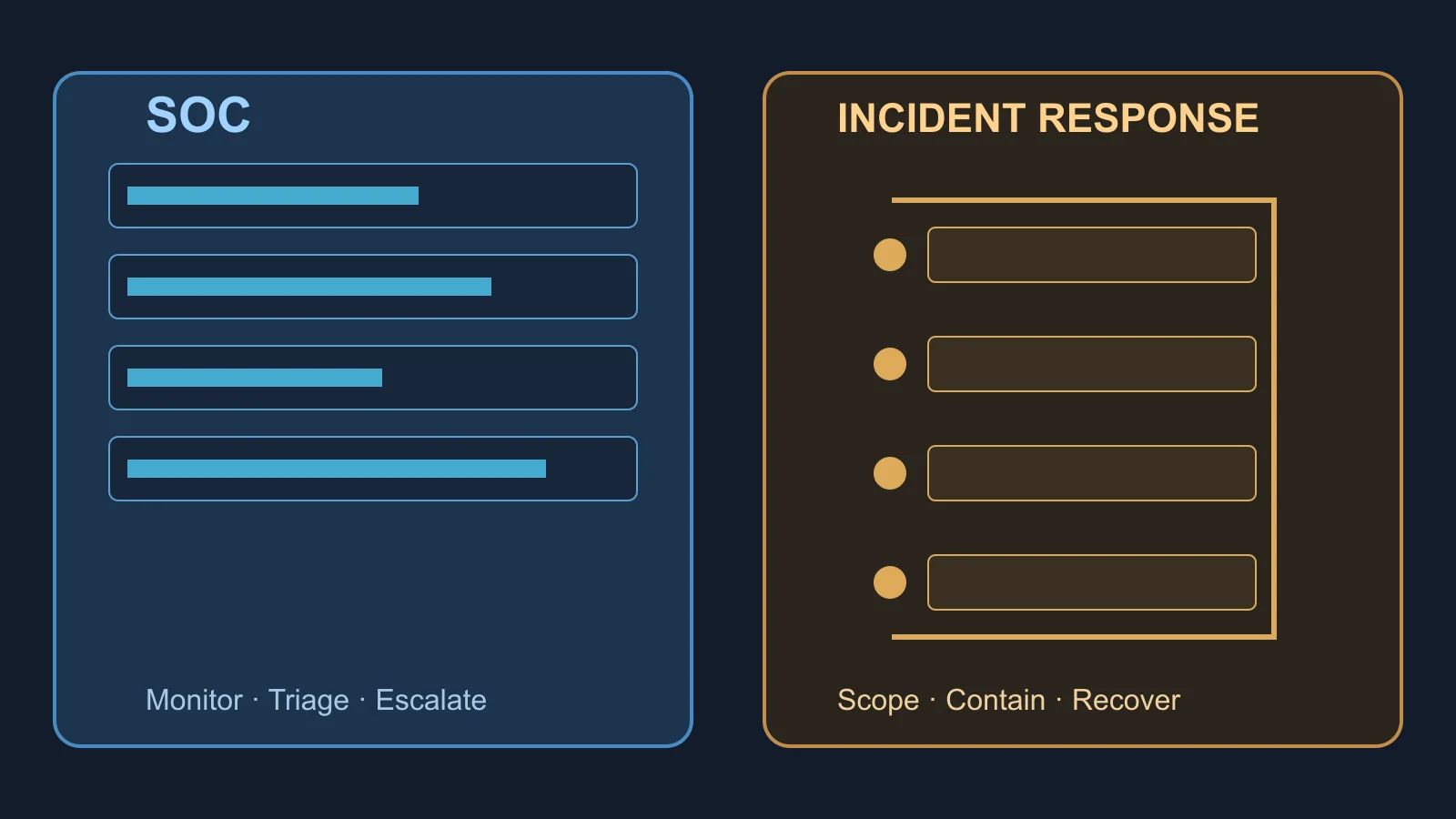
Compare SOC analyst and incident responder work: triage versus deep response, a same-incident example, how ads mix titles, and a fit checklist.