
Updated by
Hi, I'm Jack, the owner of Cybersecurity Jobs List and co-founder of Himalayas (himalayas.app) and Cavuno (cavuno.com). Across all my platforms, I work with application security daily: dependency vulnerability scanning, secure authentication, API security, and data protection across hundreds of thousands of users. My technical background is in computer science (UNSW). I studied security engineering and computer networks, and worked as a research assistant on VR experiments that were published in the Journal of Experimental Psychology. I also work with cybersecurity hiring data every day, tracking which companies are posting, what certifications actually appear in listings, how salaries differ by sub-discipline and clearance level, and where the talent gaps are widest. That combination of security practice, engineering at scale, and daily immersion in hiring data shapes the content on this site. I'm currently based in Sydney, Australia.
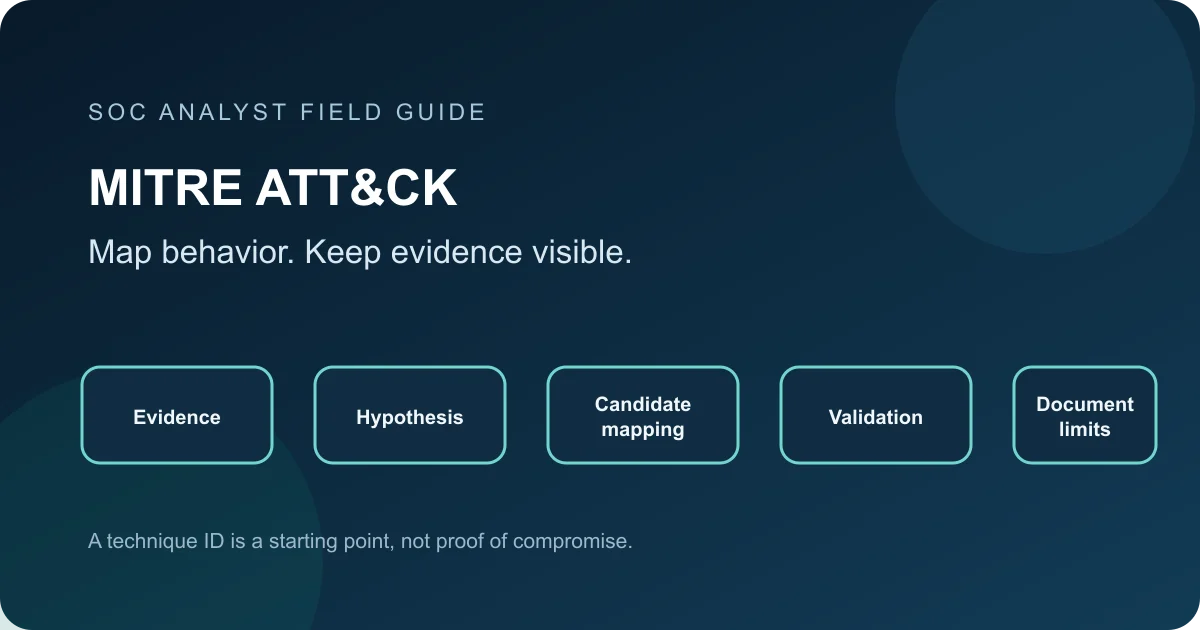
MITRE ATT&CK gives security teams a shared vocabulary for describing observed adversary behavior. For a SOC analyst, a technique ID can help explain what an alert may represent, what evidence supports that interpretation, and what should be checked next. It does not prove that an account is compromised or that a particular attacker is present.
The most useful way to learn ATT&CK is to practice careful mapping. Start with the evidence, choose a candidate technique only when it fits, and keep uncertainty visible.
What is MITRE ATT&CK?
MITRE ATT&CK is a knowledge base of adversary tactics and techniques based on observed behavior. Defenders use it to talk about threats, plan detection work, and compare what their telemetry can show. It is a reference, not a security product or a checklist you complete once.
ATT&CK organizes behavior into technology domains, including Enterprise, Mobile, and ICS. For an account, endpoint, cloud, or network alert in a business environment, start with Enterprise ATT&CK and check that the technique's documented platform matches your evidence.
What do tactic, technique, sub-technique, and procedure mean?
Think of the four terms as different levels of description. A tactic states the adversary's goal, a technique names a way to pursue it, and a sub-technique adds detail. A procedure is a specific implementation seen in an intrusion.
| ATT&CK layer | Question it answers | Example |
|---|---|---|
| Tactic | Why might the adversary be doing this? | Credential Access |
| Technique | How might they pursue that goal? | Valid Accounts, T1078 |
| Sub-technique | Which narrower form applies? | Cloud Accounts, T1078.004 |
| Procedure | What specific implementation was observed? | A documented actor's use of a particular account or tool, when a reliable source supports it |
The example column is not a claim that every use of an account is malicious. MITRE's T1078 entry describes adversaries obtaining and abusing existing credentials. A normal employee sign-in uses an existing account too. Context and corroborating evidence matter.
ATT&CK's tactics are unordered, and some may not appear in a single intrusion, as MITRE explains in its ATT&CK FAQ. Use a technique to describe evidence you have, not to guess what must happen next.
How can a SOC analyst map an alert?
Use a fictional case involving an employee account. An identity alert shows a successful sign-in from an unfamiliar location. A separate audit event shows that a new rule forwards some incoming mail to an external address. The two events happened close together, but that timing alone does not establish who created the rule or why.
Start with what the logs say:
- The account signed in successfully at a recorded time.
- The sign-in came from a location or device that needs review.
- A forwarding rule was created or changed.
- The rule sends a defined set of messages to an external destination.
Then write a hypothesis, not a verdict: “The account may have been accessed without authorization and used to collect email.” If evidence supports the account-abuse part, Valid Accounts (T1078) may be a candidate mapping. If the rule was used to gather messages, Email Forwarding Rule (T1114.003) may also fit.
Those mappings describe possible behaviors. They do not confirm that the events were adversarial. An administrator could have set the rule during an approved migration, or the employee may be traveling. Check the change owner, approval or ticket, the account's recent sign-ins, device context, rule destination, affected mailbox, and whether the same pattern appears elsewhere. Follow your team's playbook and escalation threshold if the evidence points to unauthorized access.
The written note should keep three things separate:
- Observed: the events and fields present in the logs.
- Inferred: the explanation that could connect those events.
- Unknown: the facts that still need confirmation.
That separation makes the ATT&CK mapping useful. A teammate can challenge the hypothesis, add evidence, or take over the investigation without mistaking a candidate technique for a confirmed incident.
A repeatable mapping workflow
1. Describe the behavior before searching the matrix
Summarize the event in ordinary language. “A new forwarding rule sent selected messages outside the company after an unusual sign-in” is more useful than starting with a technique ID and fitting evidence around it.
2. Check the source and context
Confirm timestamps, the identity involved, the system that generated the event, and whether related records use the same time zone and account identifier. Look for routine changes, approved work, service accounts, and known collection gaps. A weak or incomplete log should stay weak or incomplete in your note.
3. Find a candidate technique in the current ATT&CK reference
Search the technique name and read its description, platform scope, examples, and detection material. Check whether the behavior fits the entry, rather than selecting an ID because it appears in an alert title. MITRE's detection strategies can help you explore what evidence a defender might examine.
4. Record alternatives and limits
Write at least one plausible benign explanation and say what evidence would support or weaken it. If two techniques are possible, record the stronger match and explain why the evidence does not yet support the narrower mapping. It is fine to leave a technique unassigned.
5. Validate and route the finding
Ask the next question that can change the decision: who created the rule, what messages were in scope, whether the destination is authorized, and whether other accounts show the same pattern. If the event crosses your team's incident threshold, follow the approved incident-response process. ATT&CK supports that work; it does not replace it.
6. Preserve a useful detection lesson
If the event is confirmed or the investigation exposes a visibility gap, document what the current alert did and did not show. A detection improvement should be tied to evidence and tested in the organization's approved environment. A technique appearing on a matrix does not mean every organization needs the same alert.
MITRE explicitly cautions against treating ATT&CK as a 100% coverage checklist. The framework reflects observed behaviors and cannot describe every possible adversary action. Also check the current ATT&CK pages: its legacy Data Sources catalog is marked deprecated in version 18, while the current Detection Strategies reference continues to evolve.
Copyable ATT&CK mapping worksheet
| Field | What to write |
|---|---|
| Alert or question | What caused the review? |
| Observed evidence | Exact events, source systems, timestamps, and identifiers |
| Candidate behavior | Plain-language description before choosing an ID |
| Candidate ATT&CK mapping | Technique or sub-technique, with link and reason |
| Alternative explanation | A benign or different explanation that fits the evidence |
| Evidence still needed | The next record, owner, approval, or scope check |
| Confidence | Low, medium, or high, with one sentence explaining why |
| Next action and owner | The approved validation, escalation, or detection review |
Confidence is your team's assessment of this case, not an official ATT&CK score. If the evidence only supports “unusual sign-in,” say that. Don't force a mapping to make a worksheet look complete.
How should you explain ATT&CK in an interview?
Use a small example and describe your reasoning. For instance: “I would first verify the sign-in and forwarding-rule events, then check whether the rule was approved. If the evidence supported unauthorized account use and email collection, I would document T1078 and T1114.003 as candidate mappings. I would keep the observed facts separate from the hypothesis and follow the team's escalation process.”
That answer shows you can use a framework without overstating what it proves. You can practice the same discipline with the SOC analyst interview guide and the job search. The separate threat-modeling portfolio exercise is useful when you want to demonstrate a design-time skill rather than alert analysis.
A technique ID is a starting point
ATT&CK helps SOC analysts name behavior, compare evidence, and explain why they are checking something next. The quality of the analysis still comes from the evidence, context, and careful treatment of uncertainty.
Keep the observed event, your hypothesis, and the next validation step visible in every mapping. That habit is more useful in a shift handover or interview than memorizing a long list of IDs.
Related posts

Practice a first IAM interview with a failed access-removal ticket, a worked solution and clear explanations of the decisions behind it.

Compare three employer-listed product security openings by the work, geography and experience gates that may shape your fit.

Separate false alarms from benign triggers, run a seven-step triage worksheet, and practice with a labeled fictional privileged VPN alert.